The Importance of Claims Substantiation in Consumer Protection
November 21, 2025
|
Guide

Unsubstantiated marketing claims expose brands to FTC enforcement, consumer backlash, and regulatory risk. Learn what competent and reliable evidence means in practice — and how to build it into your review process.
Every claim in a campaign is a promise. Get it right and you build durable trust. Get it wrong and you invite complaints, takedowns, and avoidable risk. The difference comes down to claims substantiation: having the right evidence on hand before a claim sees the light of day, and making sure the ad’s overall impression matches what your data actually shows. Marketers who systematize claims substantiation move faster. They brief creative teams with precise claim language, pre-bake approvals, and avoid late-stage rewrites. With a clear framework, you can scale compliant storytelling without slowing down launches or asking legal to play traffic cop on every minor edit.
What Do CCPA and CPRA Actually Require From Marketing Teams?
Marketing teams must give consumers real control over how their data is used and ensure systems honor those choices immediately. Under CPRA, this means:
- Clear opt-out of the sale or sharing of personal information
- No dark patterns in consent design
- Honor Global Privacy Control (GPC) signals
- Enforce consent across analytics, ads, and CRM systems
- Maintain proof that controls actually work
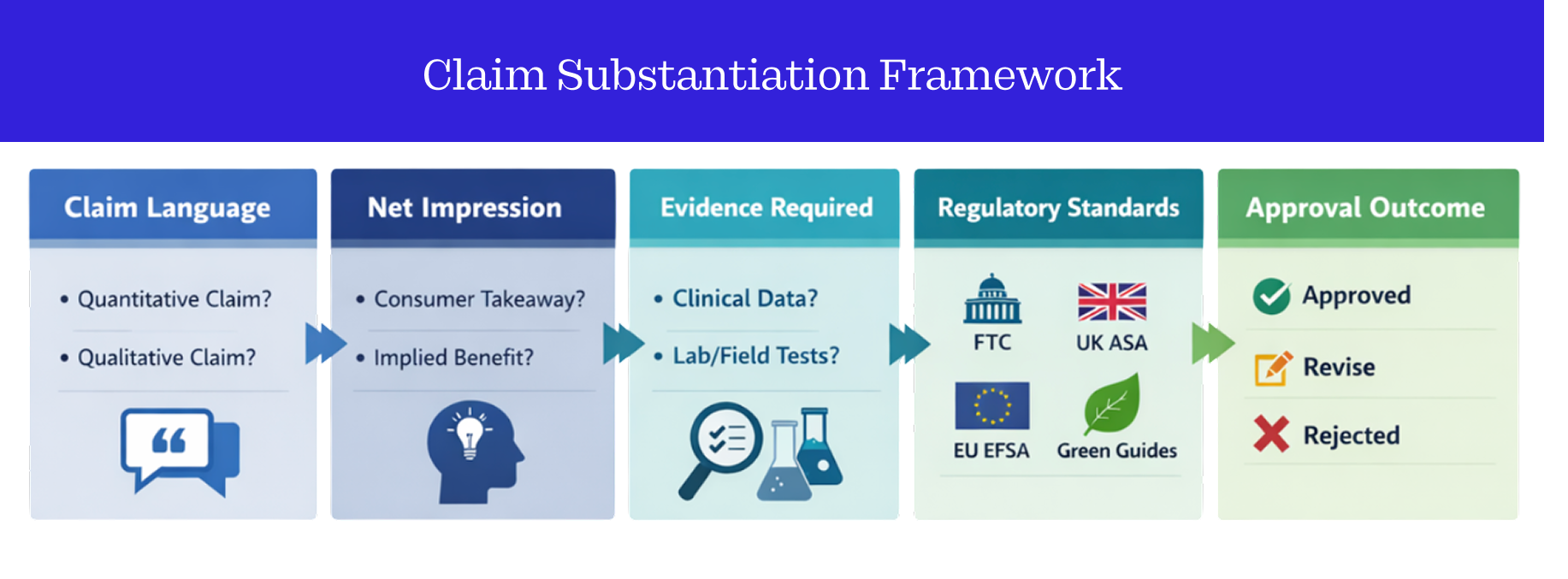
Consent is judged by outcomes, not intent. Regulators and self-regulatory bodies evaluate the net impression of your ad. That means they consider what an average consumer would take away from the wording, visuals, and context. If the impression is objective, you need evidence at the time you make the claim. If the impression is subjective puffery (think “tastes great”), formal proof isn’t required, but you still need to avoid implying a concrete benefit. Precision matters. “Removes 99% of residue” is not the same as “tough on grease.” “Authentic lavender” is not the same as “lavender scent consumers prefer.” The more specific and quantitative the promise, the tighter your proof must be. And if you’re comparing to a competitor, you must define the benchmark, compare like-for-like products, and mirror real-world conditions.
What Makes Consent Legally Valid Under CCPA and CPRA?
Consent is valid only if users have a clear, equal, and functional choice. That means:
- Accept and Decline buttons must be equally prominent
- No pre-checked boxes for marketing or tracking
- Opt-outs must work immediately
- “Do Not Sell or Share My Personal Information” must be visible where data is collected
Most violations happen when teams focus on copy but forget mechanics.
Core Frameworks Marketers Lean On
Across regions and industries, rules converge on a few principles: have credible data, hold it before you advertise, present claims clearly, and qualify them where needed. Here is a concise map of widely used frameworks and what they expect. Marketing claims frameworks at a glance:
FTC Substantiation Doctrine (United States)
Applies to all advertisers. Requires a reasonable basis for any claim. Health or performance claims must be backed by competent and reliable scientific evidence, with proof in hand before the claim is published. Stronger claims require stronger proof — clinical data for health, validated testing for performance.
UK CAP/BCAP Codes (ASA)
Covers both broadcast and non-broadcast advertising in the United Kingdom. Brands must hold documentary evidence before making any objective claim. The regulator distinguishes objective claims from puffery, and comparative ads must be fair. The net impression of the ad governs, and any testing must be relevant and representative.
EU Nutrition & Health Claims Regulation (EC 1924/2006)
Applies across the European Union for foods and supplements. Only authorized nutrition and health claims can be used, and the supporting science must meet accepted standards. EFSA approval determines the exact wording and the conditions of use.
FTC Green Guides (United States)
Covers environmental claims. Requires clear definitions, qualifiers, and boundaries for terms like “recyclable,” “biodegradable,” or “carbon neutral.” Substantiation must match the scope and limits of the environmental claim being made.
Independent validation often adds weight. Third-party labels, accredited labs, and peer-reviewed studies increase trust with consumers and with regulators. The workflow benefit is real too: when your internal sign-off can point to recognized standards and certifications, approvals move faster.
Evidence Tiers and Fit-for-Purpose Testing
Not all claims are created equal. Match the strength and type of your evidence to the promise you plan to make.
- Health or disease benefit: clinical-grade backing; randomized controlled trials, appropriate endpoints, and population fit
- Performance metric: validated lab or field tests; method mirrors consumer use; repeatable and statistically sound
- Comparative superiority: head-to-head testing vs a defined competitor or benchmark; fair conditions; like-for-like products
- Preference or sensory: blinded, well-designed consumer panels; representative sample; clear, relevant questions
Two cross-cutting rules: make the evidence product-specific where the claim implies product-level outcomes, and document everything at the time of the claim, not after complaints arrive.
Case Snapshots: When the Proof Matched the Promise, and When it Didn’t
Prego’s thick-and-chunky breakthrough was as much a testing story as a culinary one. Campbell’s commissioned large-scale, expert-designed taste tests that identified a substantial consumer segment that favored chunkier sauce. TV spots showed Prego next to Ragu Old World Style, creating a clear comparative visual. When challenged, the team clarified exactly which Ragu variety was used, keeping the comparison fair. That combination of solid sensory evidence, tight language, and a defined benchmark helped fuel huge share gains over the following years.
S.C. Johnson’s Glade “more authentic lavender” claim shows how wording can outpace a dataset. The supporting consumer survey asked about preference, not authenticity relative to a real lavender reference. Since “authentic” signals an objective anchor, preference data fell short. In contrast, “up to 50% longer lasting fragrance” had lab backing tied to a defined protocol and duration, and it held up. The lesson is simple: make your study design mirror exactly what your words imply.
Cosmetics brands often rely on home-use tests. In one lotion comparison, the marketer ran a blinded, randomized test with a representative panel, identical unmarked packaging, and pre-tested questionnaires. Results showed a statistically significant preference on scent, absorption, and feel. Claims like “users preferred [Brand] overall” mapped directly to the data. By staying close to the measured outcomes and avoiding claims outside of the survey scope, the brand gained both legal safety and marketing punch.
Environmental claims demand particular care. H&M’s “more sustainable” positioning survived a legal challenge because the language was clearly comparative and backed by documented differences in materials used for that collection. The message made the baseline explicit: more sustainable than the brand’s regular materials. Absolute claims in this space often stumble; relative, qualified claims paired with transparent disclosures tend to stand.
Finally, high-precision numbers invite high-precision scrutiny. A dish soap campaign featuring a dramatic blue-light demonstration passed review because the visual was treated as a dramatization with context. A “removes 99% of food and grease residue” line did not, since the record lacked adequate support for the specific number under conditions that matter. Numeric claims need numeric proof tied to real-use conditions, not just lab-friendly scenarios.
A Practical Checklist You Can Run Before Every Launch
Use this as a ready-to-go preflight. Adapt it by market, category, and claim type.
- Claim map: list every claim and implied takeaway; classify as objective or puffery
- Jurisdiction fit: confirm laws, codes, and industry rules for each market
- Evidence on hand: assemble studies, test reports, and datasets that match the exact wording
- Comparative clarity: define the benchmark, products compared, and test setup
- Method relevance: ensure protocols reflect real consumer use and target audience
- Quantitative claims: confirm statistics, confidence levels, and repeatability
- Qualifiers and disclosures: add context consumers need, including test conditions and limitations
- Endorsements and reviews: verify that testimonials and influencer content mirror typical results and have disclosures
- Environmental language: avoid broad terms; include percentages, timeframes, and system boundaries
- Substantiation file: store protocols, raw data, analyses, claims substantiation, credentials of labs, and approvals in one place
- Cross-functional sign-off: secure Marketing, Legal, Regulatory, and R&D approvals before publication
- Revalidation plan: set a review cadence; update evidence when formulas or market conditions change
Common Red Flags That Trigger Challenges
After a short paragraph about the checklist above, it helps teams remember specific pitfalls that keep showing up across categories.
- Vague superlatives presented as facts
- “Up to” claims without typical results
- Comparisons without a defined competitor or baseline
- Lab-only tests that ignore real-use variables
- Ingredient studies standing in for product claims
- Old data with no recent confirmation
- Certifications used out of scope
Writing Claims That Match Your Evidence
Tight, plain language is your friend. Keep the promise narrow and measurable. Add qualifiers that reflect real constraints, like “under controlled test conditions” or “compared to prior formula.” Avoid adjectives that read like facts unless you can define and measure them. When your evidence is perception-based, say so. When it is performance-based, state the metric and method.
A quick tactic for comparative claims: write the claim first, then write the test protocol that would be required to prove it. If the protocol looks impractical or unlikely to produce a durable result, rewrite the claim to something you can maintain across batches, seasons, and supply changes.
Documentation That Stands up Anywhere
A well-structured claims substantiation file speeds approvals and protects campaigns. Keep a dated index for each claim. Include protocols, raw data, statistical plans, lab credentials, and signed approvals. Save final creative assets alongside claims, so reviewers see the exact context in which the claim appears. Record where and when each asset ran.
Third-party credibility helps. Use accredited labs for performance testing and consider recognized certifications for environmental or efficiency claims. If you run clinicals, register the study and include the protocol and any amendments. If you rely on consumer testing, document sampling frames, blinding, and the questionnaire.
Operationalizing Substantiation at Scale
High-volume teams face a critical challenge: asset volume outpaces review capacity. Manual claims review becomes a bottleneck. The solution is not hiring more reviewers. It is building a system that centralizes claims, evidence, and approvals in one place.
What Works
Build a claims library. Document every approved claim tied directly to supporting evidence and the specific contexts where it is valid. When copywriters need a claim, they pull from this library rather than inventing new language. Pre-cleared claims move faster through review.
Create a routing protocol. Routine claims from your library route to a lightweight checklist. Novel claims, comparatives, and numeric claims route to experts. Tier your review so senior resources focus on judgment calls, not rote verification.
Store substantiation in one secure location. Include protocols, raw data, analyses, and approvals organized by claim type and region. When a reviewer asks why a claim was approved, you have the answer immediately. Document the approval trail alongside each creative asset.
Keep It Current
Claims substantiation is continuous practice, not a one-time gate. Set a quarterly review cadence or whenever formulas, sourcing, or market conditions shift. Train cross-functional teams on standards. Involve legal and R&D early, not after the fact.
Most brands already have the science and testing they need. The difference between friction and flow is the system: clear frameworks, right-sized evidence, precise language, tight documentation. When those pieces align, truth and speed compound.
Pulling it All Together in Everyday Work
Make claims substantiation part of the brief. When creative teams start with a clear claim, a matching test method, and the boundaries of use, they can craft headlines that land on the first try. When media teams know which claims can run in which regions, placements are smarter from day one. When legal teams see clean files and ISO-aligned methods, approvals pick up speed.
Most brands already have the science, testing, and ethics they need. The difference between friction and flow is the system around it: clear frameworks, right-sized evidence, precise language, tight documentation, and tools that keep everything connected. When those pieces click, truth and speed stop competing with each other. They compound.
Sign up for email updates
Take back your launch date.
Book a Demo