CCPA Regulations 2026: Essential Insights for Businesses
December 26, 2025
|
Guide
CCPA and CPRA compliance requirements have expanded in 2026. Get up to speed on new sensitive data categories, opt-out obligations, enforcement trends, and what marketing teams need to audit now to stay compliant.
Data privacy has become a shared concern for both consumers and organizations globally, and regulatory frameworks are now enforcing it with real teeth. California's privacy laws demonstrate this shift in action. The California Consumer Privacy Act (CCPA), as amended by the California Privacy Rights Act (CPRA), now covers not only the sale of data but also the sharing of data for cross-context targeted advertising. It sets a clear standard for what valid consent looks like and explicitly rejects consent gained through manipulative design. This represents good news for teams building with trust in mind. But it is also a wake-up call for anyone relying on legacy banners, fuzzy opt-out links, or one-size-fits-all ad pixels. Compliance requires more than general rules. Your consent flows, data-sharing contracts, and tracking setups must match what the law actually requires.
What Do CCPA and CPRA Actually Require From Marketing Teams?
Under California law, consent must be freely given, specific, informed, and unambiguous. In practice, that means a clear affirmative choice for any sensitive data use that is not required to provide the service the person asked for. It also means a fair and visible opt-out mechanism any time personal information might be sold or shared for advertising.
Minors get extra safeguards. If the person is under 16, sale or sharing requires opt-in. That opt-in must be from a parent or guardian if the child is under 13. Treat any youth-oriented campaign or product with an “affirmative only” mindset, and keep records that show how the opt-in was verified.
Sensitive personal information is now a distinct category. Precise location, health details, biometric identifiers, racial or religious data, and certain financial information fall in this bucket. If you plan to use any of this for marketing or brand personalization that goes beyond delivering the requested service, treat it as opt-in. Ask clearly, store the decision, and make it just as easy to say no as it is to say yes.
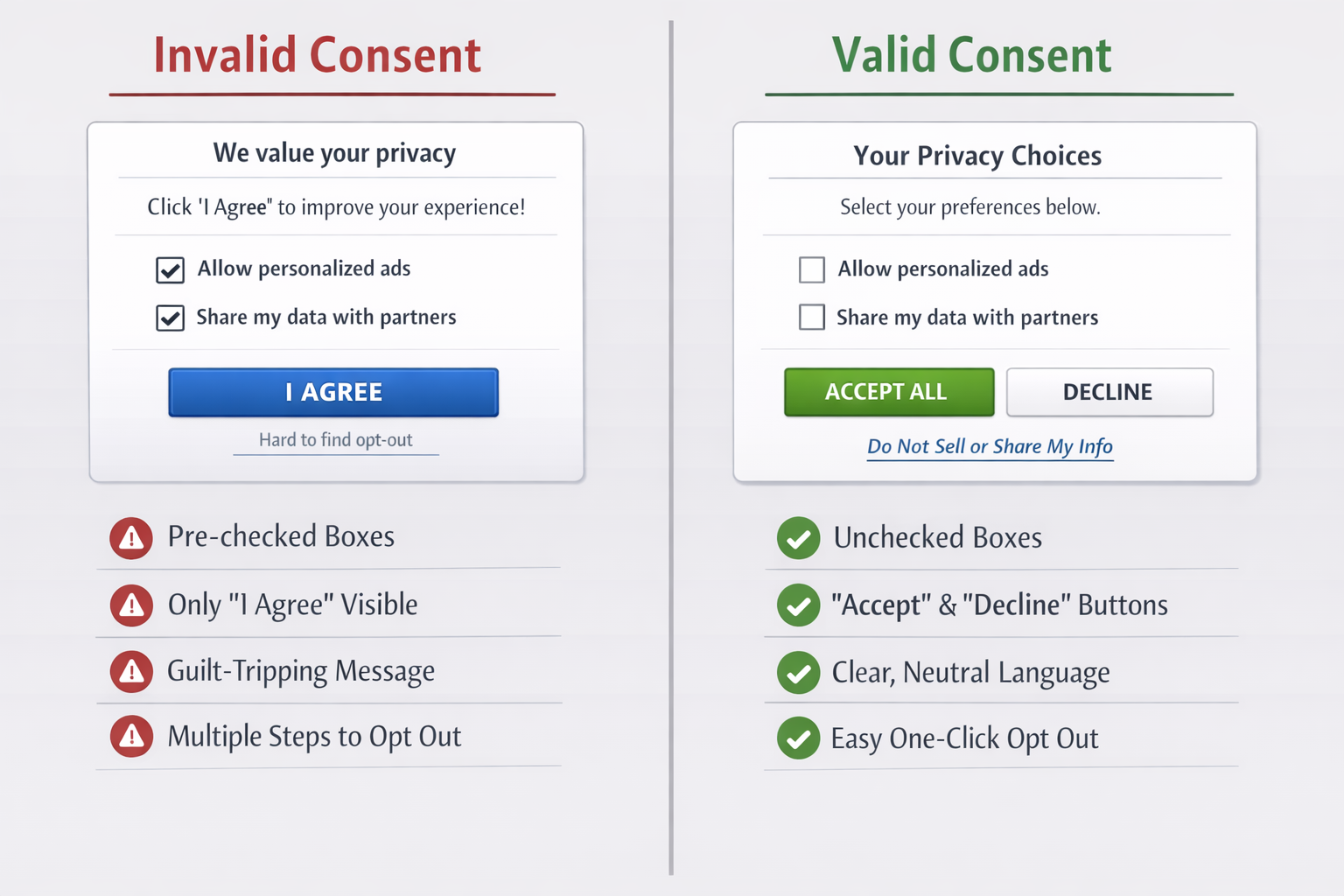
One more point that changes day-to-day UX choices: any consent captured through a dark pattern does not count. If users are nudged, tricked, or slowed down in order to accept tracking, that “agreement” is invalid. Equal prominence for Accept and Decline, no pre-ticked boxes, no guilt language. The state’s privacy regulator has said the effect of the design is what matters when ensuring compliance with regulation.
What’s the Difference Between a Sale, a Share, and a Service Provider Under CPRA?
Marketing programs touch a lot of vendors. Whether the law treats a data transfer as a sale or share depends on what the recipient is allowed to do with the data. If the partner acts only on your instructions and is bound by a contract that forbids independent use, it fits the service provider model. That is not a sale or share.
Give a third party the ability to reuse the data for its own purposes, or ship identifiers to an ad network for cross-site targeting, and you have a sale or share. You must post a conspicuous “Do Not Sell or Share My Personal Information” link, honor opt-outs, and stop any sale or sharing for anyone who opts out or signals Global Privacy Control in their browser.
The bright line shows up in the headlines. When brands sent data that revealed health conditions or precise browsing to ad platforms and failed to offer a working opt-out, regulators acted. California’s Attorney General settled with Healthline for $1.55 million and required program fixes. Sephora wrote a check too. The pattern is clear: labels on a banner are not enough if the pipes still flow.
What Does Valid Consent Mean Under CCPA and CPRA?
Design choices decide whether your consent is valid. Teams often focus on copy and forget the mechanics. Make it effortless for users to say yes or no, and make sure the choice does what it says in code.
- Clear Accept and Decline buttons, same prominence and one-click each.
- No pre-checked boxes for marketing, analytics, or cross-site tracking.
- A visible “Do Not Sell or Share” link on every page where data is collected is crucial for CCPA compliance.
- An unsubscribe link that works immediately, no maze of confirmation screens.
Marketing should also test consent in the real world. Use a clean browser profile. Click Decline. Verify that ad pixels, third-party tags, and marketing automation do not activate for that session or user. Repeat with Global Privacy Control turned on. Document the results. A regulator will expect you to prove the controls work, as required by regulation, not just show screenshots of the banner.
How Should Marketing Teams Enforce Consent Across Their Systems?
Consent is not only a banner. It is a set of connected systems. Start with your consent platform. Configure it to capture choice logs for at least 24 months. When a user opts out, that state should sync to your analytics, ad platforms, and CRM. Add a “sale/share opt-out” flag to customer profiles and ensure audience builders and suppression lists respect it. Preference centers help where you maintain direct relationships. Let customers toggle topics and channels in one place, and make sure unsubscribe and opt-out states cover both email and advertising IDs. If you support login, store and reapply choices across sessions and devices. Treat Global Privacy Control like a first-class signal. If a browser sends GPC, your site should disable sale and sharing by default for that session. If the user later opts in, you can lift the restriction. Until then, do not pass identifiers to ad partners. Finally, keep your privacy notice current. If you add a new ad network or start using a new category of data, update the notice and give people an easy path to opt out. The law expects your public statements to match your practice, particularly in alignment with standards like GDPR.
How Should Vendors Be Managed to Meet CCPA and CPRA Audit Requirements?
Contracts with ad tech, agencies, analytics firms, and data processors need specific clauses. They should limit use to the business purpose you define, ban onward sale or sharing, require deletion or suppression after an opt-out, and prevent combining your data with other sources unless you have approved it. The law also contemplates audits. Give yourself a right to review. Ask for evidence that the vendor honors opt-out signals and deletes data on request. If a partner cannot meet these obligations, treat them as a third party rather than a service provider, and adjust your flows and notices accordingly. Enforcement shows that “trusting the industry framework” is not enough. Healthline believed its partners followed a standard privacy code, but the lack of contract terms and proof became part of the problem. Write it down, test it, and keep the receipts.
What Records and Proof Do Regulators Expect for Consent Compliance?
Logs are your insurance. Keep a record of every opt-out, preference change, and consent event for at least two years. Store the date, the mechanism used, and the assets or cookies affected. If you are ever asked how you handled a specific request, you can answer with facts, not guesses. Timing matters too. When someone opts out, the sale or sharing needs to stop without delay. Set up automations that push suppression to ad platforms quickly. If you use nightly batch jobs, make that window explicit in your policy and shorten it where you can. A simple internal dashboard helps. Track the number of opt-out requests processed, average time to enact suppression across channels, percentage of pages with working “Do Not Sell or Share” links, and GPC detection rates. Treat these like delivery metrics, not just compliance stats.
How Can UX Teams Avoid Dark Patterns in Consent Design?
Your designers and growth marketers will appreciate concrete guardrails. Share this list and build it into your design system.
- Balanced choices: Accept and Decline buttons with equal size, color, and placement.
- Plain language: avoid double negatives, legalese, or guilt-driven copy.
- Direct paths: no extra clicks to refuse compared to accept.
- No bundling: separate consent for unrelated purposes, no all-or-nothing toggles.
- Visible exits: “Do Not Sell or Share” links placed where users expect to find them.
What Does Good Consent Execution Look Like in Practice?
Picture a first visit to your site. A banner appears with two equal buttons: Accept All and Decline Non-Essential. A link in the banner jumps to a granular preference panel with clear toggles. The site recognizes a GPC signal and defaults to off for sale and sharing. Tracking scripts stay dormant until the person opts in. If the person creates an account, the preference center shows past choices, offers channel-by-channel control, and carries those choices to email and ads. A CRM flag drives suppression across your ESP, CDP, and media platforms. Every change is timestamped. Every campaign audience builder checks those flags automatically.
Your vendor contracts include CPRA-required terms. Ad platforms and agencies receive only the data they need, ensuring CCPA compliance, regulation adherence, and only for the uses you specify. You run a quarterly audit where a privacy champion clicks through the flows, confirms GPC behavior, validates suppression in downstream tools, and ensures all practices align with GDPR requirements. Findings go into a simple report that product, legal, and marketing can all read.
How Do Marketing Teams Accidentally Violate Consent Rules?
Most consent violations do not come from legal decisions. They come from day-to-day marketing operations. Marketing teams often move faster than compliance processes, which creates gaps where consent rules are unintentionally broken. These violations are rarely intentional. They happen because consent enforcement is treated as a one-time setup instead of an ongoing operational system. Common ways this happens include:
- Adding pixels or scripts without review
New analytics tools, ad pixels, or A/B testing scripts are deployed without checking whether they fire before consent or respect opt-outs. - Reusing audiences after users opt out
Retargeting or CRM audiences continue to be used even after users withdraw consent, especially when suppression lists are not synced across platforms. - Copying consent templates across regions
A banner designed for one jurisdiction is reused globally, even though consent requirements differ by region. - CMS updates that bypass consent logic
Website redesigns or CMS changes accidentally remove or override consent controls, causing data to flow before preferences are applied.
How Should Marketing Compliance Change as Regulations Evolve?
As privacy enforcement matures, marketing compliance is shifting away from surface-level signals toward system-level enforcement. Regulators are increasingly focused on whether consent is actually honored in practice, not just whether a banner exists. Key shifts marketing teams should prepare for include:
- From banners to system enforcement
Compliance is judged by what systems do with data, not what interfaces display. - Greater emphasis on audit trails
Teams must show when consent was given or withdrawn, how it was enforced, and where proof is stored. - Stronger vendor accountability
Brands are expected to understand and control how vendors process data, not assume compliance by default. - Continuous monitoring over point-in-time checks
Compliance is no longer a one-time launch task. It requires ongoing validation as tools, vendors, and content change.
This evolution means marketing compliance must be built into workflows and infrastructure. Teams that rely on static banners or manual checks will struggle to keep up as enforcement expectations increase
How Can Marketing Teams Test Consent Compliance in Real Conditions?
Here are lightweight exercises that catch most issues before they turn into headlines.
- Cookie banner parity test
- GPC signal verification
- Opt-out to audience suppression timing check
- Page-by-page “Do Not Sell or Share” link audit
- Vendor pixel scan on opt-out sessions
- Contract clause spot-check
How Can Teams Scale Marketing Compliance Without Slowing Down?
Puntt AI helps marketing and legal teams scale these controls without piling on headcount. Our AI-powered compliance engine reviews marketing assets at high volume, flags consent design issues that could be viewed as dark patterns, and checks that required links and disclosures appear where they should. Because the platform is integrated, approvals move quickly across teams. Marketing can route new pages, banners, emails, and ad creative for automated policy checks, while legal sees an audit trail and risk scores. When you change a vendor or add a new pixel, Puntt AI can trigger reviews across affected assets so the right clauses and notices are in place.
Data security sits at the core. Reviews happen in a secure environment, with privacy-by-default handling of any sample data needed for testing. The result is a faster, cleaner go-to-market process that respects consent, honors opt-outs, and minimizes risk. Privacy choices should be obvious, respectful, and instant. Build that foundation, and your campaigns will reach the right people with the right level of trust.
Sign up for email updates
Take back your launch date.
Book a Demo