How to Design a Brand Compliance Workflow That Scales
November 28, 2025
|
Guide
Ad hoc approvals break down as teams grow. Learn how to design a brand compliance workflow with clear risk tiers, automated checks, and cross-functional accountability that scales without slowing creative output.
Brand consistency is easy when you are shipping a small number of assets to one market. The real challenge of brand compliance begins as teams multiply, markets expand, and content volume accelerates. At that point, manual approvals and scattered brand guidelines stop scaling and start creating risk, from inconsistent execution to regulatory exposure. Brand compliance is the discipline of ensuring every asset aligns with approved standards and requirements, and at scale it must be enforced by systems, not memory. Effective compliance is built into the production pipeline itself, with smart checks where risk is highest and automation where it delivers the most value, so teams can move fast without sacrificing control.
Who This Applies To?
Brand, marketing operations, creative operations, and regional marketing teams managing high-volume content across multiple markets, channels, and partners where approvals, templates, licenses, and brand rules must be enforced consistently.
Key Terms
- Brand compliance: Adherence to approved brand identity, messaging, and required disclosures
- Brand drift: Gradual deviation from approved standards over time
- Quality gate: A checkpoint that blocks or records compliance before progression
- Audit trail: Timestamped approvals, versions, and rationale linked to each asset
What Is Scalable Brand Compliance?
Scalable brand compliance means ensuring every asset stays on-brand, approved, and auditable as content volume, teams, and markets grow—without relying on manual reviews or slowing launch timelines. At small scale, compliance is enforced by people remembering rules. At scale, memory fails. What replaces it must be systems, not heroics. Scalable compliance is not rigid control. It is predictable enforcement.
A scalable brand compliance workflow mirrors the asset lifecycle. It starts with a single source of truth for the brand, carries standards into briefs and templates, routes work to the right people at the right moments, and keeps a defensible audit trail. When the campaign goes live, the system monitors usage, retires outdated assets, and enforces corrective actions when needed. Crucially, scalability means you can double or triple volume without doubling or tripling the friction. That is achieved through clear governance checkpoints, modular processes, and integrated platforms that speak to each other. People still make the final calls. Technology shortens the path to those calls and eliminates preventable errors.
How Do You Build a Brand Compliance Workflow From Brief to Archive?
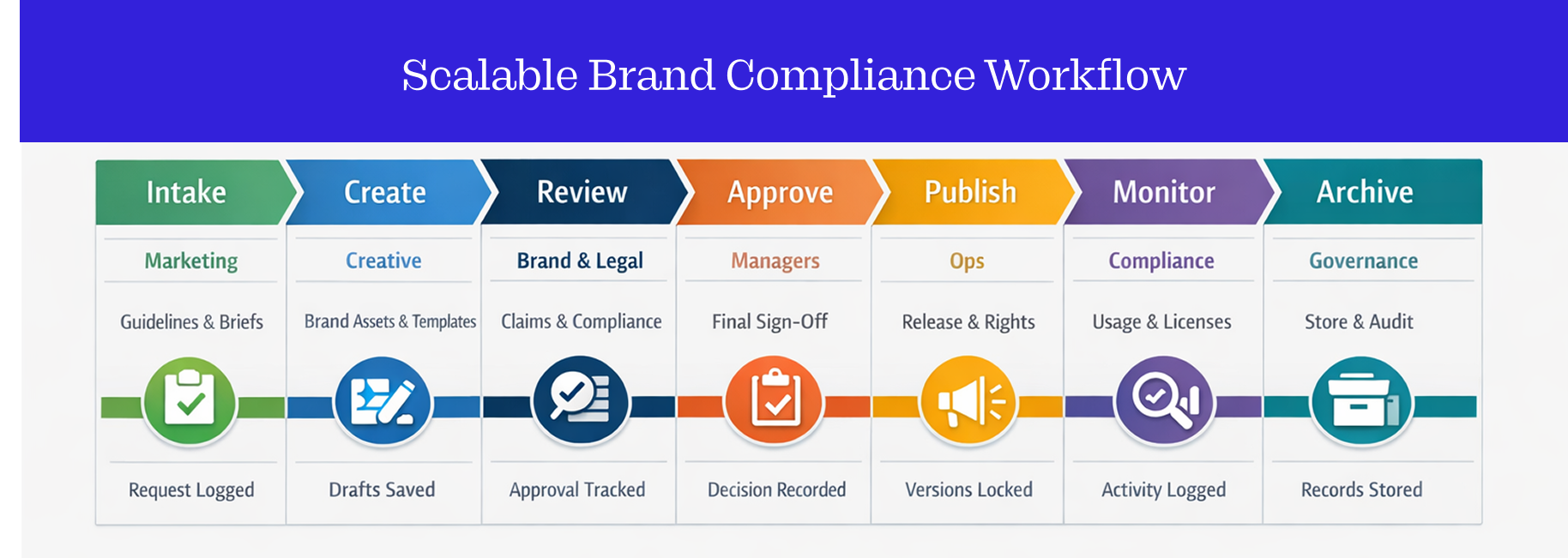
Most teams think of compliance as a review step. In reality, it is a pipeline that starts before creation and continues after launch. A scalable brand compliance workflow defines owners, checks, and evidence at every stage from briefing through archiving, ensuring rules are enforced before errors reach the market. Canonical lifecycle model:
- Brief
- Create
- Review
- Release
- Monitor
- Enforce
- Archive
If you cannot point to who owns compliance, what is checked, and where proof is stored at each stage, the workflow will not scale. However, when this pipeline lives inside connected tools, you replace long email threads with traceable comments, you eliminate asset hunting, and you ship at pace without gambling on quality.
What Quality Gates Prevent Brand Drift at Scale?
A quality gate is not another person on the CC line. It is a verified step where rules are checked and recorded before work moves forward. Think hard blocks on missing disclaimers, checklist completions in proofing tools, and required approvals by role, not by name. Effective quality gates are specific and automated where possible. Examples include:
- Off-palette color detection
- Incorrect logo usage
- Missing disclaimers
- Expired licenses
- Unapproved claims language
Good gates are specific. Creative teams see exactly which color values or spacing rules they violated because the proofing system overlays annotations. Legal sees every claim in context, with reference links. Regional teams sign off on local sensitivities. These gates do not slow you down when the asset is correct. They only slow the wrong work.
What Should Be Automated vs Reviewed by Humans?
Not everything should be automated. Not everything should be reviewed.
Automate first:
- Asset tagging and metadata validation
- Logo, color, and typography rules
- Missing or expired disclaimers
- License expiration checks
- Template enforcement
Keep human review for:
- Nuance in tone or cultural context
- Edge-case legal or regulatory claims
- Brand judgment calls that require interpretation
Automation should reduce volume, not replace judgment.
How Do You Connect Tools and Teams for Brand Compliance?
No single platform solves brand compliance. The winning move is to make your collaboration tools, DAM, workflow engine, and QA scanners play together while assigning clear accountability.
- Source of truth: Central brand portal and DAM in alignment with brand guidelines
- Production and proofing: Creative apps with templates, online proofing
- Routing: Workflow engine that assigns by role, geography, and asset type
- Communication: In-tool comments, Slack or Teams alerts, email only for summaries
- Evidence: Versioned approvals, time-stamped decisions, exportable audit trails
With this orchestration, creative teams design inside guardrails, reviewers work from the same context, and operations can answer the most common question in seconds: who approved this and why.
Automation That Grows With You
Automation is not about removing people. It is about removing guesswork and rework.
Dynamic routing sends a product page with a price claim to legal and compliance in parallel while a brand video in Spanish skips legal but requires regional review. Prebuilt templates for slides, product sheets, and social formats carry the latest fonts and logos directly into authoring tools so the right choices are the default. AI can auto-tag assets, spot off-palette colors, and flag expired stock images before anyone hits publish.
The biggest gains appear when you embed compliance, including brand compliance, where work happens. Pandora placed up-to-date brand templates inside Microsoft Office, auto-flagging outdated elements at creation time. Lufthansa centralized guidelines and assets in a single brand portal so teams did not remix old materials. Skate brand NHS moved to an automated proofing workflow for external licensees, routing hundreds of proofs daily to the right creative directors. These are the same moves any growing brand can adopt.
Designing for Growth From Day One
Start modular. Each step of the workflow should be replaceable and upgradable without tearing down the whole system. Intake and brief forms become configurable blocks. The compliance check becomes a reusable component that can be attached to a new channel tomorrow. Invest early in role-driven logic. Workflows should look up who holds the role Finance Approver or Local Market Lead today, not hardcode names that will change. Add sandbox environments to test tweaks safely, and build a small library of workflow components like social post approval or video caption compliance that you can assemble as needs change. Keep governance visible. Every participant should see where an asset sits in the process, who owes what, and which checklists remain. Visibility accelerates throughput, because ambiguity is the real bottleneck.
Operating Model That Balances Control and Speed
Centralized brand governance creates clarity, but local producers know their markets. A hybrid model tends to scale best. Headquarters provides the core identity, approved templates, and the portal. Local teams co-create within those guardrails and submit variants for review.
That setup encourages healthy tension. The brand stays coherent while local campaigns feel relevant. A quarterly rhythm of joint reviews between central and regional leaders keeps rules modern and pragmatic.
What Metrics Should You Track for Brand Compliance?
Measure the health of the system and you will keep improving it. Share the results widely so everyone sees progress and friction.
- First-pass approval rate
- Average review duration by asset type
- Post-publication violations caught
- Template adoption vs custom designs
- Percentage of assets with complete metadata
- Rights violations and expired asset usage
Dashboards that trend these metrics by region and channel reveal where training is needed, which gates may be overly strict, where brand compliance is ensured, and where automation would pay off next.
Bringing AI into the Review Loop With Confidence
AI has matured into a reliable partner for repetitive checks. It can inspect thousands of assets per day for brand-safe colors, spacing, or unauthorized logos. It can scan for missing disclaimers or identify statements that may require legal review. It can check rights metadata and license windows so expired imagery never slips through.
Ensuring brand compliance, guided by clear brand guidelines, is crucial in maintaining brand integrity and credibility across all platforms. By setting clear guidelines and automating compliance checks, organizations reduce the risk of inconsistencies and potential legal issues. AI systems excel at processing large volumes of data, flagging discrepancies early and allowing brand managers to focus on strategic oversight. With brand compliance deeply integrated into the workflow, teams can confidently create and distribute content that aligns with overarching brand standards.
What AI should not do is make final judgments on context, taste, or regulatory nuance. That is where experienced brand managers and counsel shine. The winning model pairs always-on AI screening with human sign-off for the edge cases that actually matter.
What Are the Most Common Brand Compliance Failures and Fixes?
Complexity creeps in quietly. Too many approvers, unclear exceptions, or disconnected tools can erase your gains. Keep a bias for clarity and automation, and prune regularly. Small improvements here prevent big headaches later.
- Ambiguous ownership: Define who owns identity, who owns legal, and who can approve exceptions.
- Template sprawl: Maintain a small, curated set of templates and retire outdated ones aggressively.
- Email dependence: Centralize feedback in the proofing system so decisions are searchable and auditable.
- One-off workflows: Standardize on a few patterns and extend them with conditional logic rather than cloning bespoke flows for every team.
What Good Looks Like
The best scaled programs feel boring in the right ways. Creators reach for a template and never think twice about the latest logo. Reviewers see assets in context, approve quickly, and leave fewer comments. Legal intervenes on meaningful risks, not missing commas. Leadership sees trend lines moving in the right direction. The brand shows up the same way in Tokyo and Toronto, with the right local inflection. This is doable with today’s tools, a thoughtful operating model, and a willingness to tune as you go. The payoff is compounding. Every compliant asset teaches the system what good looks like, and every iteration removes a little more friction.
Sign up for email updates
Take back your launch date.
Book a Demo