Brand Compliance: Best Practices for Success in 2026
December 30, 2025
|
Guide
A 2026-ready compliance playbook for marketing teams: pre-publish checklists, AI content disclosure rules, privacy and green claims standards, and the tech stack that keeps every asset on-brand and audit-ready.
Marketing compliance is the system that ensures every asset is on-brand, legally safe, accessible, and auditable before it goes live. Brand rules, platform policies, privacy obligations, accessibility standards, and industry regulations now intersect on every campaign. This guide is a practical, 2026-ready marketing compliance playbook for busy teams and agencies, shaped by thousands of real creative reviews and modern AI checks that catch issues before work goes live. The goal is simple: consistent, compliant creative that performs, without the last-minute uncertainty of whether legal will sign off.
Who This Applies To?
Marketing teams and agencies publishing high-volume creative across multiple platforms; especially in CPG or regulated industries or any company using tracking, claims, or AI-generated media.
What Changed About Brand Compliance in 2026?
Brand compliance in 2026 is the system that keeps every asset consistent, lawful, accessible, and auditable across channels. It’s no longer a PDF and an email thread, but enforcement embedded in tools and workflows. Standards shift faster than brand books update. Privacy rules continue to expand. Platforms are updating AI content policies. Environmental claims now face scrutiny that demands measurable proof. The old method of a PDF guideline, a shared drive, and a scramble in email threads no longer holds up.
Brand compliance is not only about protecting trademarks and color codes. It is the backbone of credibility. When every asset is consistent, accessible, lawful, and respectful, audiences reward you with attention and trust. When you can prove that discipline with an audit trail, executives and regulators take notice. The good news: you can build a modern compliance engine without slowing creativity. With the right checklist, tools, and workflow, your team can publish with confidence and keep the brand sharp across every channel.
What Should Marketers Check Before Publishing in 2026?
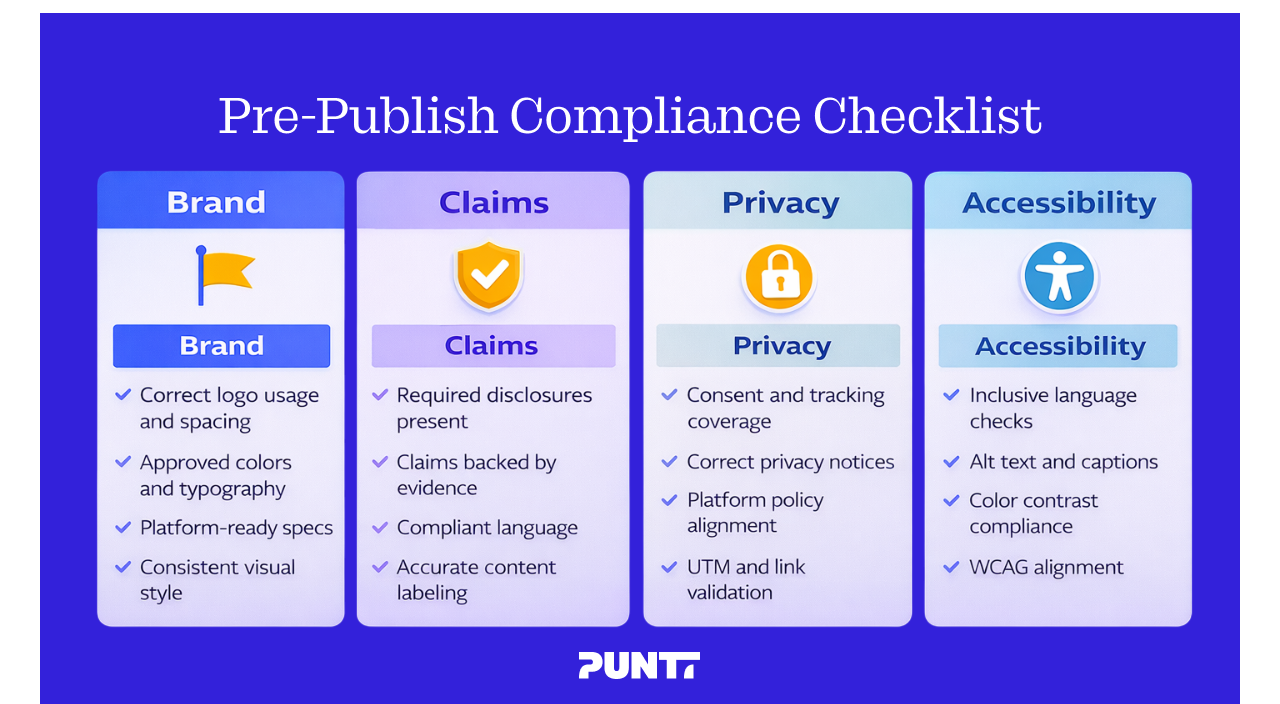
Most issues are preventable with a clear set of checks. Make this the default gate that every asset passes before it gets scheduled or shipped.
- Correct logo and spacing rules
- Approved color palette and type hierarchy
- Platform-ready specs and metadata
- Required disclosures and attributions
- Substantiated claims and compliant vocabulary
- Accessibility checks and inclusive language
- Privacy and consent coverage for tracking
- Live link validation and UTM consistency
What Tools Prevent Brand Drift and Compliance Delays?
Technology should remove ambiguity, keep teams in sync, and automate the tedious parts of compliance. Pair that with a clear approval path and you accelerate quality, not just speed.
A Stack That Actually Enforces Standards
Digital Asset Management systems, including Brandfolder, Bynder, and Widen, centralize approved assets with version control and permissions so no one pulls the wrong logo or last year’s color palette. Creative proofing tools like Ziflow, Filestage, and Workfront support annotated review, route content to the right approvers, and push final versions back into the DAM automatically. Version history in Figma or Drive protects collaborators from “wrong draft” chaos, and auto-numbered releases give everyone a single source of truth. The missing piece has been proactive checks that catch problems in real time.
This is where Puntt comes in. Our platform applies adaptive AI inspectors across brand, regulatory, platform, accessibility, and best practice rules, checking in Google Docs, Microsoft Word, Jira, and design workflows. Inspectors update automatically as rules change, flag missing disclaimers or incorrect logo treatments, and provide platform-specific optimization guidance. The same engine monitors live pages and ads to catch drift and keep you audit ready without manual sweeps.
Cross-Team Flow That Scales
Creative does not need five layers of sign-off for every banner, but it does need clarity. Define who approves which element, from copy to claims to imagery. Use structured review rounds, not infinite comments, to reduce churn and control scope creep. Automation should notify approvers, log timestamps, and pull comments into an audit trail without PM ping-pong. Dashboards help leaders see bottlenecks early. Kanban for status. Gantt for timelines. SLA indicators for legal reviews. Give each stakeholder accountability and a visible deadline.
Training That Sticks
Brand guideline workshops and e-learning refreshers keep teams aligned on new logos, voice updates, accessibility, and legal changes. Encourage certification where appropriate, from FTC advertising practices to inclusive marketing and GDPR. Make onboarding concrete with cheat sheets and “this, not that” examples. Cross-functional sessions between marketing, legal, and product reduce friction and surprises when a launch is on the line.
From Kickoff to Monitoring, Step-by-Step
A repeatable framework prevents last-minute surprises. Use your DAM templates at drafting, route to compliance for IP, claims, and disclosures, then audit technical details before scheduling. After publishing, monitor usage and document history for audits and learnings. This is the default pre-publish gate we recommend for most teams.
Which Compliance Rules Should Marketing Teams Prepare For Next?
Privacy, green marketing, and AI transparency standards are tightening. Your checklist must account for these trends to keep risk low and trust high. Data privacy is widening its scope. California’s CPRA expands sensitive data and strengthens opt-out rights, while updates across the US and UK are raising penalties and enforcement. Laws aimed at protecting minors restrict targeted advertising to under-17s in several contexts. This means consent management needs to be explicit, and cookies and pixels must be audited with real rigor.
Environmental claims face sharper scrutiny. Absolute phrases like “carbon neutral” or “100 percent recycled” require solid evidence and context, not a footnote. Regulators expect clarity on whether improvements come from reductions or offsets and may reject broad statements that lack specificity. Use measurable baselines and make your methodology public.
AI-generated media is shifting from novelty to regulated content. The EU AI Act will require labels for synthetic images, audio, and video in many contexts. Major platforms are adopting policies that demand clear disclosures for realistic AI content, with enforcement expected to ramp up through 2025 and beyond. Your review pipeline should detect and label synthetic media before it publishes.
Before these rules catch you unprepared, put focused actions on the calendar.
- Consent and pixels: Audit tracking, refresh consent flows, honor opt-out and deletion requests across ad platforms and CRM.
- Kids and teens: Tighten data collection and targeting rules for under-17 audiences, restrict personalized ads where required.
- Green claims substantiation: Build evidence files with baselines, methodologies, and source links for every environmental statement.
- AI content disclosures: Label synthetic scenes, keep provenance data, and store verification artifacts for audits.
- Platform policy alignment: Compare social and ad policies to your templates and macros, update badges, hashtags, and disclosure placements.
- Accessibility uplift: Move to WCAG 2.2 AA checks, raise contrast, and standardize captions and transcripts across video and social.
How Do Compliance Requirements Change by Industry?
Financial services marketing must be fair, balanced, and not misleading. Performance claims need context, realistic benchmarks, and risk statements that are as prominent as outcomes. FINRA’s guidance makes the stakes clear, and approvals often require additional sign-offs and archival standards. Make templates that pull risk language automatically wherever performance is referenced.
Healthcare and pharmaceutical promotions require a fair balance between benefits and risks and must align with approved labeling. Evidence is not optional, and aiming beyond indications can trigger serious penalties. Bake medical and legal review into every draft and use structured slots for mandatory safety statements and “always read the label” language (fda.gov). Alcohol and beverage campaigns should show only adults, avoid youthful appeal, and never imply health or social benefits. Encourage moderation, and use responsible consumption cues advised by relevant self-regulatory bodies (adstandards.ie). Creative should be designed with placements in mind to reduce the risk of underage exposure.
What Metrics Keep Marketing Compliance Audit-Ready?
Compliance improves when it is visible. Track cycle time to approval, number of issues caught by automated checks, rework volume by category, and live drift incidents detected post-publish. Watch false positives as well. The goal is a tighter loop, not more noise. Create a simple approval map per campaign that lists who signs off on copy, visuals, claims, and platforms, including backups. Store decisions and timestamps in your workflow tool or in Puntt’s audit log so you can answer the inevitable questions six months later. If you can replay what went live and why, you can fix faster and defend choices with confidence.
Finally, stretch beyond risk mitigation into performance. When creative is compliant, accessible, and consistent, engagement improves, and platforms reward clean, policy-aligned content. Puntt adds platform-specific optimization insights to the same checks that protect you, so every approval round moves the work forward rather than just clearing a hurdle. Publishing with discipline does not need to slow you down. With a checklist tuned for 2026, adaptive AI screens, and a workflow that keeps people aligned, your brand meets higher standards and earns the trust that compounds campaign after campaign.
Frequently Asked Questions About Marketing Compliance in 2026
What is marketing compliance in 2026?
Marketing compliance in 2026 is the system that ensures every asset is on-brand, legally sound, accessible, and auditable before and after it goes live across channels.
What checks should happen before publishing marketing content?
Before publishing, teams should verify brand usage, disclosures, substantiated claims, accessibility, privacy and consent coverage, platform specifications, and live links.
Which compliance rules are changing the fastest?
Privacy regulations, environmental marketing standards, and AI-generated content disclosure requirements are evolving most rapidly and require proactive monitoring.
What tools reduce compliance review time?
Tools that embed compliance checks directly into creation and workflow—such as DAMs, proofing systems, and adaptive AI inspection—reduce review time by catching issues early and routing approvals automatically.
What metrics show that compliance is working?
Shorter approval cycles, fewer post-publish fixes, reduced rework, consistent audit trails, and lower drift incidents indicate a healthy compliance system.
Final Thought
Publishing with discipline does not need to slow creativity. With a modern checklist, adaptive checks, and a workflow that aligns people and tools, teams can meet higher standards while moving faster and earning trust campaign after campaign.
Sign up for email updates
Take back your launch date.
Book a Demo